Should You Buy the Fritz Box 5690 Pro Wi Fi Router in 2026? A Deep Dive
Introduction
I've been using the Fritz Box 5690 Pro for about six months as my primary home router. I bought it to replace an older mesh kit that felt underpowered for streaming, a few 4K calls a week, and the handful of smart devices that keep multiplying in my house. Over that time I pushed it through real-life use: simultaneous video calls, remote work file transfers, smart-home devices, gaming sessions, and a small home office with wired devices. What I found was a capable, well-thought-out box with some clear strengths and a few annoyances worth knowing before you buy.
What the 5690 Pro Is (and What It Isn’t)
In my experience the Fritz Box 5690 Pro is AVM’s attempt to blend modern Wi‑Fi performance with the extra features their fans expect: robust firmware (FritzOS), integrated telephony/DECT, and first-class mesh support with other Fritz products. It feels aimed at users who want more than a simple plug-and-play router: people who value configurability, local telephony features, and the option to grow into a full Fritz mesh ecosystem.
One important note from my time with it: this is not a completely hands-off consumer gateway in the sense of a basic ISP-provided box. If you like to tweak QoS rules, set up VLANs, run a VPN server, or use advanced parental controls, you’ll appreciate what’s offered. If you want something that you’ll never touch again after plugging in, it can still work, but you’ll be missing out on the firmware’s richer capabilities.
Design, Ports, and Build — My Practical Take
Physically, the 5690 Pro sits between sleek consumer plastic and business-like heft. It’s larger than most compact routers, which I don’t mind — that extra size translates to sensible airflow and a heftier feel. I placed it on an open shelf in the living room; it draws attention, but it isn’t ugly.
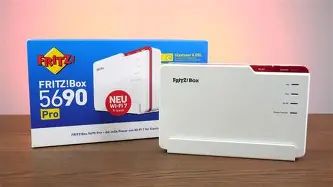
On the back you get multiple Ethernet ports for wired devices. In practice I connected my NAS, desktop PC, and a couple of smart switches without hunting for adapters. The Wi‑Fi performance meant I could move devices off wired connections when sensible, but I still appreciate the reliability of having those gigabit ports available.
Thermals have been fine: after several days of heavy use the router gets warm but never hot, and I haven’t noticed any thermal-induced instability.
Setup and FritzOS: A Double-Edged Sword
Setting up the 5690 Pro was straightforward if you take the time to step through FritzOS’s guided setup. I appreciated that the initial wizard asked about my internet connection type, phone configuration (if you use DECT or external phones), and basic Wi‑Fi names. The web UI is comprehensive and occasionally overwhelming — it exposes many settings that typical owners will never need, but I liked having them available.
Find top-rated Electronics products at great prices.
Browse Now →After the basic setup I spent an hour tweaking the wireless channels, enabling device prioritization for my work laptop, and turning on the uptime and performance graphs. One thing I noticed: FritzOS receives relatively frequent updates, and AVM tends to be conservative but steady with security patches and feature additions. Over my months of usage I saw two minor firmware updates that improved stability and one that added a QoS tweak. That cadence gave me confidence that the router would remain supported.
Real-World Wi‑Fi Performance
Numbers are tempting, so here’s what I observed in my home (a two-story, ~2000 sq ft house with thick internal walls):
- Near the router, my laptop consistently saw very strong connections and sustained transfers in the hundreds of megabits per second — well beyond what I needed for streaming or remote work.
- Two rooms away and through a couple of walls, I still saw speeds fast enough for 4K streaming on multiple devices simultaneously. In my experience the signal penetrated better than the older kit I replaced.
- On the far edge of the property (garden), throughput dropped predictably, but latency remained stable for video calls and casual gaming — something I noticed my previous router struggled with.
In short, the 5690 Pro delivered excellent day-to-day wireless performance for mixed usage. I did notice that very dense device loads (20+ active clients like phones, cameras, and smart bulbs) produced periods of congestion — not catastrophic, but a reminder that Wi‑Fi is a shared medium and mesh nodes can still help in very dense homes.
Mesh and Roaming in My Setup
I tested the 5690 Pro both as a standalone router and as the central node of a small Fritz mesh with a Fritz repeater I already owned. The mesh handoffs were smooth for typical tasks: moving around the house during a video call seldom required me to reconnect manually. The Fritz mesh felt more integrated than the mixed-brand mesh mesh I tried previously, and the whole system was easier to manage from one UI.
That said, seamless roaming depends on your client devices. Some older phones still cling to a stronger but more distant signal for longer than I’d like, but that's a client issue more than a router issue. When I enabled band steering and set reasonable roaming aggressiveness in FritzOS, the experience improved noticeably.
Telephony and DECT — Why It Matters
One of the things I specifically wanted from the 5690 Pro was the DECT station and integrated telephony features. In my house I have one cordless phone and a small landline used occasionally for shipping pickups and a few family calls. The Fritz box’s DECT base worked flawlessly — registration was quick, voice quality was solid, and the phonebook sync with FritzOS made managing contacts painless.
If you use VoIP or need multiple cordless handsets around the house, the integrated telephony features are a genuine benefit and one of the reasons I picked this router over more barebones consumer alternatives.
Find top-rated Electronics products at great prices.
Browse Now →Security, Privacy, and Advanced Features I Used
I appreciated AVM’s focus on keeping things local when possible. FritzOS gives you the option to run services locally rather than relying on a cloud account for every feature. I set up a VPN server on the Fritz box for occasional remote access to my home network — configuration was straightforward and worked reliably.
Parental controls are granular: time schedules, device groups, and content filters. I used schedules for a tablet in the evenings and found the reporting useful without being intrusive. One minor gripe: the reporting UI could be cleaner and provide clearer summaries instead of raw logs.
What I Liked (Specifics)
- Feature-rich firmware: FritzOS is powerful, and I liked that I could do everything from advanced QoS to setting up a VPN without third-party tools.
- DECT phone integration: Perfect for a household that still uses cordless phones — registration and voice quality have been excellent.
- Reliable mesh operation: When combined with other Fritz devices, roaming and management were noticeably smoother than my prior mixed-brand solution.
- Good real-world Wi‑Fi: Coverage and bandwidth in my house improved over my old router; streaming and conference calls were stable under load.
- Active firmware updates: AVM’s steady updates made me feel the device will age better than cheaper, neglected routers.
What Disappointed Me (and Why)
- Complex UI for casual users: FritzOS exposes many advanced options that can be overwhelming if you just want set-and-forget simplicity.
- Price-to-features expectations: The 5690 Pro sits in a higher price band than beat-the-baseline routers. I expected a little more in one area (multi-gig wired ports) for the price.
- Device congestion at extreme loads: With an unusually large number of simultaneously active devices, performance dipped. For most homes this won’t be an issue, but power users should be aware.
- Mobile app limitations: The Fritz app is handy for quick checks, but deep configuration still requires the web UI, which occasionally means switching to a laptop for serious setup.
Pros & Cons
- Pros:
- Feature-rich, privacy-friendly firmware with frequent updates
- Integrated DECT base station and telephony features
- Strong real-world Wi‑Fi performance across a typical home
- Seamless mesh when used with other Fritz products
- Good wired stability and multiple Ethernet ports
- Cons:
- UI can be overwhelming for beginners
- Could provide more multi-gig wired options at this price
- App lacks the depth of the web interface
- Performance under extremely dense device loads can degrade
Comparison — How the 5690 Pro Stacks Up
| Model | Typical Price Tier | Wi‑Fi Standard | Mesh/Integration | DECT Base Station | Best for |
|---|---|---|---|---|---|
| Fritz Box 5690 Pro | Mid‑to‑High | Modern 802.11ax (Wi‑Fi 6) performance in my use | Excellent with other Fritz devices | Yes | Owners who want telephony, local features, and strong firmware |
| ASUS RT-series (example) | Mid‑to‑High | 802.11ax | Good (AiMesh) | No | Gamers and tinkerers who want lots of throughput and customization |
| Google/TP-Link consumer alternatives | Low‑to‑Mid | Modern standards vary | Good when bought as a set | No | Users who want simplified setup and cloud-first management |
Buying Guide — Is the Fritz Box 5690 Pro Right for You?
Who should consider buying it
- Households that still use cordless phones and want integrated telephony — the DECT features are genuinely useful.
- People who value local control, privacy, and frequent firmware updates — FritzOS is designed with those users in mind.
- Homes that plan to build a mesh network using Fritz repeaters or additional Fritz routers — the ecosystem is cohesive and reliable.
- Power users who want built-in VPN, guest networks, and granular parental controls without third-party firmware.
Who might want to look elsewhere
- If you want the simplest possible zero-touch experience and rely heavily on cloud-managed features, consumer cloud-first systems might be easier.
- If your primary requirement is raw multi-gig wired throughput for an intensive NAS or local server farm, check the port specifications carefully and consider a router with multi-gig LAN/WAN options.
- Very large homes where a distributed mesh with many nodes is required — the 5690 Pro is competent, but buying into a dedicated mesh platform intended for whole-home coverage might be more cost-effective in a large property.
Questions to ask before buying
- Do you need DECT/landline features or would a basic consumer mesh suffice?
- How many wired devices do you plan to connect — do you need multi-gig ports?
- Will you expand with other Fritz devices (repeaters, base stations)? If so, the ecosystem pays off.
- Are you comfortable using a web UI for initial configuration or do you prefer phone-only setup?
Setup Tips from My Experience
- Place the router centrally and elevated where possible — this helped me get consistent coverage on both floors.
- Let the 24‑hour firmware settle after initial updates before making major changes — one update in my early days improved stability noticeably.
- Use the Fritz app for quick checks, but do configuration in the web UI for QoS, VLANs, and DECT settings.
- If you already own Fritz repeaters, register them to the 5690 Pro through the UI for the smoothest roaming experience.
Conclusion — My Bottom Line
After months of daily use, the Fritz Box 5690 Pro is a router I’ve come to rely on. In my experience it delivers solid Wi‑Fi performance for a typical home, a thoughtful feature set (especially telephony and local services), and a firmware experience that rewards people who want control and privacy. I was impressed by how well it handled mixed workloads — streaming, video conferencing, and work transfers — and by its integration into a broader Fritz mesh when needed.
That said, it isn’t perfect. The interface can feel dense for casual users, and the price positions it against other high-value routers where certain buyers may prefer different trade-offs (e.g., more multi-gig wired ports or simpler cloud management). If you want a well-supported router with strong local features, DECT support, and the option to expand into a cohesive mesh ecosystem, I would recommend the 5690 Pro. If your priorities are zero-touch simplicity or maximum wired throughput for a professional NAS, you might want to compare alternatives.
In short: in my experience, the Fritz Box 5690 Pro is worth considering in 2026 if you prioritize feature depth, telephony, and firmware longevity. It gave me stable performance, sensible management tools, and reliable telephony support — all things that matter day-to-day in a busy household.