Doom The Dark Ages Specs, Features, and Value: Is it worth the price tag?
The announcement of Doom: The Dark Ages has sent shockwaves through the gaming community, signaling a bold shift for one of the most storied franchises in electronics and software history. Developed by id Software and published by Bethesda Softworks, this upcoming prequel to Doom (2016) and Doom Eternal promises to transport players back to the origins of the Doom Slayer’s legendary rage. In an era where modern gaming hardware is being pushed to its absolute limits, Doom: The Dark Ages represents more than just a sequel; it is a technical showcase of the id Tech engine, designed to leverage the power of current-gen consoles and high-end PC components. For consumers navigating a market defined by rising software prices and hardware requirements, the central question remains: does this medieval-inspired gore-fest provide enough innovation, performance, and longevity to justify its spot in a premium entertainment budget?
Technical Specifications and Performance Expectations
At the heart of the Doom: The Dark Ages experience is the latest iteration of the id Tech engine. Known for its industry-leading optimization, id Tech has historically delivered high frame rates even on modest hardware, but The Dark Ages appears to be raising the ceiling. Unlike its predecessors, which were cross-generational titles, this installment is built exclusively for the PlayStation 5, Xbox Series X|S, and PC, allowing the developers to discard the limitations of older hardware architectures.
For PC enthusiasts, the hardware demands reflect a shift toward high-speed NVMe storage and multi-threaded CPU processing. While official finalized spec sheets often fluctuate near launch, the architectural demands suggest a baseline requirement of at least 16GB of DDR4 or DDR5 RAM and a GPU with substantial VRAM to handle the increased texture density of the "dark fantasy" world. Early technical deep dives indicate that the game utilizes a revamped global illumination system and advanced particle physics, essential for rendering the shattered, gothic landscapes and the massive scale of the new "world-boss" encounters.
On the console front, players can expect the traditional "Performance" and "Fidelity" modes. Given the franchise's emphasis on twitch-reflex combat, the target for most users will be a consistent 60 frames per second (FPS) at a dynamic 4K resolution. However, there are whispers of a 120Hz mode for those with HDMI 2.1-compliant displays, providing the ultra-low latency input that competitive-level Doom players crave. The integration of the PlayStation 5’s DualSense haptic feedback and adaptive triggers is also a significant technical feature, intended to make every swing of the new Shield Saw feel tactile and impactful.
Core Features: A Medieval Evolution of Combat
The most striking feature of Doom: The Dark Ages is its departure from the high-tech, industrial sci-fi aesthetic of the previous two entries. By shifting to a dark fantasy setting, id Software has introduced a suite of gameplay mechanics that fundamentally alter the "combat puzzle" for which the series is famous. The introduction of the Shield Saw—a combination of a defensive buckler and a motorized chainsaw—adds a layer of parrying and projectile reflection that was previously absent. This shifts the player’s focus from pure evasion to a more aggressive, front-facing defensive posture.
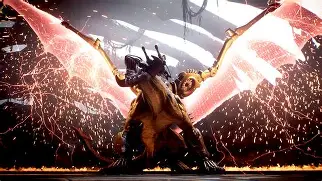
Another major feature is the increased scale of warfare. While previous games focused on tight, arena-based skirmishes, The Dark Ages introduces massive, open-field battles where the Doom Slayer can pilot a giant "Atlan" mech or ride a cybernetic dragon. These vehicle-based segments are not merely cinematic set-pieces; they are fully integrated features with their own upgrade paths and tactical nuances. The inclusion of the "Flail," a heavy melee weapon that harvests resources from enemies, further leans into the medieval theme while maintaining the "glory kill" loop that ensures the player remains in constant motion.
The weapon sandbox has also been overhauled. Players will have access to the Super Shotgun—a franchise staple—rendered here in a more primitive, rugged form. New additions like the "Skull Crusher" (which grinds up demon remains to fire as shrapnel) showcase the developer's commitment to creative, brutal weaponry. From a buyer's perspective, this indicates a high level of "feature density," where the variety of tools available ensures that the gameplay remains fresh over a long campaign.
Find top-rated Electronics products at great prices.
See Deals →Pros and Cons for the Modern Gamer
When evaluating the value of a high-priced electronics purchase like a modern AAA game, it is essential to weigh the innovations against potential drawbacks. Doom: The Dark Ages is a premium product, and its success hinges on its ability to satisfy both hardcore fans and newcomers.
- Pro: Cutting-Edge Optimization. The id Tech engine continues to be a gold standard for performance, likely ensuring a smooth experience even on mid-range hardware.
- Pro: Unique Aesthetic Pivot. The "Doom-meets-medieval" style offers a fresh visual and mechanical pallet that distinguishes it from the sea of futuristic shooters.
- Pro: Enhanced Mechanical Depth. The parry system and Shield Saw add a new skill ceiling for veteran players to master.
- Pro: Massive Scale. The introduction of mechs and dragons expands the scope of the game beyond typical corridors, offering better variety.
- Con: Higher Hardware Entry Barrier. Moving away from last-gen consoles means some players will need to invest in new hardware to play.
- Con: Melee Focus Polarization. Players who preferred the pure gunplay of Doom (2016) may find the increased emphasis on flails and shields to be a distraction.
- Con: Potential Complexity. With more systems to manage (shield, flail, guns, mechs), there is a risk of the UI and controls becoming cluttered for casual users.
Comparison: The Dark Ages vs. Previous Generations
To understand the value proposition, it helps to compare the technical and feature-based offerings of The Dark Ages against its predecessor, Doom Eternal. This comparison highlights where the extra "value" in the price tag is actually going.
| Feature/Spec | Doom Eternal (2020) | Doom The Dark Ages (2025/26) |
|---|---|---|
| Engine | id Tech 7 | Latest id Tech Evolution |
| Platform Support | Cross-gen (PS4/Xbox One to PS5/Series X) | True Next-Gen Only (PS5/Series X/PC) |
| Primary Movement | Dash and Double Jump | Heavy, Grounded with Parry Mechanics |
| Vehicle Combat | Minimal (Scripted moments) | Integrated (Atlan Mechs, Flying Wyverns) |
| World Design | Segmented Arenas | Large-Scale War Zones & Open Vistas |
| Melee Weaponry | Doomblade (Execution only) | Shield Saw & Flail (Active Combat) |
Buying Guide: Is Your Setup Ready?
Before committing to the purchase price of Doom: The Dark Ages, buyers should evaluate their current electronics ecosystem. This is a "heavy" title that demands specific hardware features to be enjoyed as intended. For PC users, the first priority should be the storage solution. The asset streaming required for the game’s massive vistas and high-resolution textures will likely make a SATA SSD the absolute minimum, with an NVMe PCIe 4.0 drive highly recommended to eliminate loading stutters.
Regarding the GPU, users looking for the "intended" experience at 1440p or 4K should look at cards with at least 12GB of VRAM. Ray-tracing features are expected to be a major component of the lighting engine, so NVIDIA RTX or AMD RX 6000/7000 series users will have a distinct advantage in visual fidelity. If you are still running a quad-core CPU, this may be the title that finally necessitates an upgrade to a 6-core or 8-core processor to handle the sheer volume of AI entities on screen at once.
For console gamers, the choice is simpler but equally important. If you own an Xbox Series S, realize that while the game will run, the visual compromises in resolution and texture quality will be significant compared to the Series X. Furthermore, for the best audio experience, consider a headset that supports 3D spatial audio (like the Pulse 3D or high-end SteelSeries equivalents), as the sound design—once again featuring a heavy-metal inspired score—is integral to the "value" of the immersion.
When considering the price at launch, typically ranging from $60 to $70 USD for the standard edition, prospective buyers should look at the "replayability" factor. Historically, Doom games offer substantial value through "Ultra Nightmare" modes, collectable secrets, and post-launch support. If you are a player who enjoys mastering mechanics and replaying levels for better times or higher difficulties, the price-per-hour of entertainment here is exceptionally low. However, for those who only play through a campaign once and ignore side content, waiting for a seasonal sale might be the more prudent financial move.
Find top-rated Electronics products at great prices.
Shop Amazon →Real-World Use Cases and User Care
What do buyers typically care about when a major title like this drops? For many, it is the "pick-up-and-play" factor. In real-world use, gaming is often a decompression tool. The Doom series has perfected the "flow state"—that psychological pocket where the player is fully immersed in the rhythm of the game. The Dark Ages appears to be doubling down on this, creating a world where the electronics (the console/PC and controllers) disappear, and only the feedback loop of the game remains.
Parents and gift-buyers should note the "Mature" rating, which is a hallmark of the series. The value here is in the technical artistry of the "gore" and the satisfaction of the combat, which is strictly targeted at an adult audience. From an electronics maintenance perspective, games this demanding will cause consoles and PCs to generate significant heat. It is a good time to ensure your hardware is properly ventilated and free of dust before the game’s release to prevent thermal throttling during intense boss fights.
Conclusion
Doom: The Dark Ages stands as a testament to the enduring appeal of visceral, well-crafted action. By moving the clock back on the narrative while simultaneously pushing the technology forward, id Software has created a product that feels both nostalgic and futuristic. The transition to a "next-gen only" status means the game is unburdened by the ghosts of older hardware, resulting in a cleaner, more ambitious technical presentation. While the shift toward more deliberate, parry-based combat might require an adjustment period for those accustomed to the frantic air-dashing of the previous entry, the addition of mechs, dragons, and the ingenious Shield Saw provides a wealth of new content that feels earned rather than tacked on.
The value of the price tag ultimately depends on what you seek from your electronics. If you value technical polish, a rock-solid frame rate, and a game that respects your time by offering a dense, high-quality experience without unnecessary "padding," then Doom: The Dark Ages is likely to be a premier investment. It is not just another shooter; it is an architectural marvel of software engineering that utilizes every watt of power your modern gaming rig can provide. As we move further into the current console generation, this title looks poised to be the benchmark against which all other action games are measured, making it an essential addition to any enthusiast's digital library.