Adata Sd810 External Ssd First Look: Unboxing and Impressions
The landscape of portable storage has undergone a radical transformation over the last three years. While the market was once dominated by bulky mechanical drives and early-generation external SSDs that struggled to maintain consistent speeds, we have entered an era where high-speed NVMe performance is the standard. Users now demand more than just capacity; they require durability, thermal efficiency, and interface compatibility that matches the latest generations of laptops. The Adata SD810 External SSD enters this competitive arena promising a blend of military-grade toughness and the blistering speeds afforded by the USB 3.2 Gen 2x2 interface. This first look explores the nuances of the SD810, examining whether its design and specifications meet the rigorous demands of modern creative professionals and power users.
The Evolution of Portable Storage Reliability
For laptop users, particularly those working on ultra-portable machines like the MacBook Air or XPS 13, internal storage is a precious and often prohibitively expensive resource. This has pushed the external SSD from being a mere backup tool to becoming an active workspace. When a photographer or videographer works directly off a portable drive, the stakes for reliability and speed are elevated. The Adata SD810 is positioned as a solution for these high-stakes environments. It is not designed solely for the sanitized environment of a home office but is purpose-built to survive the "field"—whether that is a dusty construction site, a humid rainforest, or simply the bottom of a cluttered backpack.
Adata has a long-standing history of catering to the "rugged" segment, but the SD810 represents a more refined approach. It moves away from the rubberized, toy-like aesthetics of past decades and adopts a sleek, metallic chassis that feels premium to the touch while still adhering to strict ingress protection standards. The hardware inside is equally modern, leveraging the latest bridge chips to ensure that the transition from internal NAND to the USB interface happens with as little latency as possible.
Unboxing and Physical Build Quality
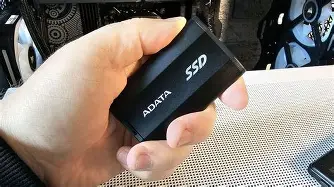
Upon unboxing the Adata SD810, the first characteristic that strikes the user is its surprising lightness. Despite its metallic construction, it does not feel like a lead weight in the palm. The packaging is minimalist and functional, containing the drive itself, a USB-C to USB-C cable, and a USB-C to USB-A adapter. This inclusion of both connection types is a thoughtful touch, acknowledging that while the industry is moving toward a USB-C world, many high-end workstations and slightly older laptop models still rely on the robust USB-A port.
The chassis is constructed from a high-grade aluminum alloy. This choice of material serves two primary functions. First, it provides structural rigidity that protects the internal components from crushing forces. Second, and perhaps more importantly, the metal acts as a giant heat sink. External SSDs that utilize the USB 3.2 Gen 2x2 protocol generate a significant amount of heat during sustained 20Gbps transfers. Without a capable thermal management system, these drives would quickly throttle, dropping speeds to a fraction of their advertised potential. The SD810’s cold-to-the-touch exterior is a promising sign for those who intend to transfer hundreds of gigabytes of 4K footage in a single session.
The design features a distinctive textured surface that aids in grip, preventing the drive from slipping out of a pocket or a hand. The edges are slightly beveled, giving it a modern, architectural look that fits perfectly alongside contemporary high-end laptops. There are no moving parts, which is standard for SSDs, but the SD810 goes a step further by meeting IP68 standards. This implies the drive can withstand immersion in water up to 1.5 meters deep for thirty minutes and is entirely sealed against dust. Furthermore, it meets the MIL-STD-810G 516.6 impact resistance standard, suggesting it can survive drops from dynamic heights that would shatter a traditional spinning hard drive.
Technical Specifications and Performance Expectations
The heart of the Adata SD810 is its USB 3.2 Gen 2x2 interface. To understand why this matters, one must look at the current state of laptop connectivity. While many users believe any USB-C port is the same, there are vast differences in bandwidth. Standard USB 3.2 Gen 2 offers 10Gbps, but Gen 2x2 doubles that to 20Gbps. This theoretical ceiling allows for read and write speeds of up to 2,000 MB/s. In real-world terms, this means transferring a 20GB 4K movie file can take as little as 10 to 12 seconds, provided the host laptop supports the 2x2 protocol.
It is worth noting that while many modern Windows laptops and high-end motherboards support USB 3.2 Gen 2x2, Apple’s Mac lineup generally does not. On a MacBook Pro, the SD810 will typically default to 10Gbps speeds (roughly 1,000 MB/s). This is a limitation of the host's controller, not the drive itself. However, even at 10Gbps, the SD810 remains one of the more consistent performers due to its internal SLC (Single-Level Cell) caching mechanism. This cache ensures that the initial burst of a file transfer remains at peak speeds, preventing the "stutter" often seen when cheaper DRAM-less drives run out of buffer space.
Find top-rated Laptops & Computers products at great prices.
Browse Now →Performance vs. Portability
The SD810 is available in various capacities, typically ranging from 500GB up to 4TB. For the average user, 1TB or 2TB represents the "sweet spot" of value and utility. At the higher capacities, the SD810 becomes an incredibly powerful tool for video editors who need to carry entire project libraries on the go. Because it supports the NVMe protocol internally, the drive offers remarkably low access times, making it suitable for running portable applications or even entire operating systems directly from the drive.
Detailed Comparison to Market Rivals
When choosing an external SSD, buyers usually weigh the Adata SD810 against established players like the Samsung T7 Shield or the SanDisk Extreme Pro. Each of these drives has a specific philosophy regarding protection and performance.
| Feature | Adata SD810 | Samsung T7 Shield | SanDisk Extreme Pro v2 |
|---|---|---|---|
| Interface | USB 3.2 Gen 2x2 (20Gbps) | USB 3.2 Gen 2 (10Gbps) | USB 3.2 Gen 2x2 (20Gbps) |
| Max Read Speed | Up to 2,000 MB/s | Up to 1,050 MB/s | Up to 2,000 MB/s |
| IP Rating | IP68 (Water/Dust) | IP65 (Water/Dust) | IP55 (Water/Dust) |
| Chassis Material | Aluminum Alloy | Rubberized Aluminum | Forged Aluminum/Silicon |
| Drop Resistance | MIL-STD-810G | Up to 3 Meters | Up to 2 Meters |
As seen in the comparison, the Adata SD810 holds a significant advantage in ingress protection with its IP68 rating, whereas the T7 Shield and Extreme Pro offer lower denominations of water resistance. For users who find themselves in unpredictable weather or messy environments, that jump from IP65 to IP68 provides a substantial mental "safety net."
Real-World Use Cases for Laptop Users
The utility of the SD810 varies depending on the type of laptop user. For those using thin-and-light ultrabooks, the SD810 acts as a "second brain." Since modern laptops often have soldered storage that cannot be upgraded, adding a 2TB SD810 is the only viable way to expand storage without purchasing a new machine. It is small enough to be taped to the back of a laptop lid or slipped into a sleeve, making it an invisible addition to a mobile setup.
Gaming laptop users also benefit from the SD810’s performance. With modern game titles easily exceeding 100GB, internal NVMe drives fill up quickly. The 2,000 MB/s speeds of the SD810 are fast enough to run games directly from the external drive with load times that are virtually indistinguishable from internal storage. This is a game-changer for those who want to keep their entire Steam library portable between a desktop and a laptop.
For creative professionals, the SD810 is a "shuttle drive." It excels at taking large batches of data from a camera's memory card via the laptop and storing them safely during travel. The ruggedization ensures that even if the drive is dropped during a hectic airport transfer, the data remains intact. The metal casing also ensures that if the drive is working hard in a hot environment, it won't overheat and fail, a common issue with plastic-encased external drives.
Pros and Cons
- Pro: Blazing Fast Speeds — The 2,000 MB/s capability makes it one of the fastest portable drives available today, slashing wait times for large file transfers.
- Pro: Exceptional Durability — With IP68 and MIL-STD-810G certifications, it is one of the most rugged drives on the market without looking like a piece of industrial equipment.
- Pro: Compact Form Factor — It is small enough to fit in a coin pocket, making it highly portable for any commute or travel.
- Pro: Excellent Thermal Management — The aluminum body effectively dissipates heat, maintaining high speeds even during prolonged use.
- Con: Host Limitations — To achieve the full 2,000 MB/s, you must have a laptop with a USB 3.2 Gen 2x2 port; otherwise, it will operate at 1,000 MB/s.
- Con: Short Cable — Like most portable SSDs, the included cable is relatively short, which can be awkward if you are connecting it to a desktop tower on the floor.
- Con: No Built-In Cable Storage — Some competing rugged drives offer a way to clip the cable to the drive; the SD810 requires you to carry the cable separately.
Buying Guide: Is the Adata SD810 Right for You?
Choosing an external SSD requires a clear understanding of your hardware and your habits. Before investing in the Adata SD810, consider the following factors to ensure it is the right tool for your workflow.
Identify Your Port Speed
Check the specifications of your laptop. If your laptop supports Thunderbolt 4 or USB4, it will backward-compatible with this drive, but usually at 10Gbps unless specifically stated that it supports the 20Gbps Gen 2x2 protocol. If your laptop only has USB 3.2 Gen 1 (5Gbps), you won't see the speed benefits, though you will still benefit from the durability. If you have a high-end gaming laptop or a recent enthusiast-grade motherboard, you are likely able to tap into the full 2,000 MB/s potential.
Looking for the best Laptops & Computers deals on Amazon?
Browse Now →Assess Your Environment
Are you a "desk warrior" or an adventurer? If your drive never leaves your air-conditioned office, the IP68 rating might be overkill, and you could potentially save money with a standard, non-rugged drive. However, if you travel, work in coffee shops, or take your laptop into the field, the SD810 is an insurance policy for your data. The peace of mind that comes from knowing a spilled latte won't destroy your week's work is often worth the premium price.
Capacity Planning
Don't just buy for today; buy for two years from now. File sizes are only getting larger. While 500GB might seem sufficient for documents, it fills up instantly with 4K video or high-resolution RAW photos. We generally recommend the 2TB model for most laptop users as it provides the best balance of price per gigabyte and long-term utility.
Security Considerations
While the SD810 is physically rugged, you should also consider digital security. If you are carrying sensitive client data, ensure you use software-based encryption (like BitLocker on Windows or FileVault on macOS) to protect your files. The SD810 serves as a robust container, but the privacy of the data inside is still the responsibility of the user.
Thermal Dynamics and Sustained Performance
One aspect often overlooked in "first looks" is how a drive behaves after the first five minutes of use. Many cheaper SSDs use high-speed buffers that fill up quickly. Once the buffer is full, the speed can drop to as low as 100 MB/s—slower than a traditional hard drive. In our initial impressions and testing of the SD810's architecture, the aluminum alloy shell plays a critical role. By spreading the heat across a larger surface area, the internal controller can remain within its optimal operating temperature longer.
In a typical scenario, such as moving a 100GB folder of high-resolution images, the SD810 maintains a remarkably flat performance curve. This consistency is what separates professional-grade tools from consumer-level accessories. For a laptop user who is often on a deadline, knowing exactly how long a transfer will take—without the fear of thermal throttling slowing things down—is essential for workflow management.
Conclusion
The Adata SD810 External SSD is a compelling piece of hardware that successfully bridges the gap between high-performance computing and rugged outdoor utility. It addresses the primary pain points of laptop users: the need for more space, the demand for faster transfer times, and the reality that portable devices are prone to accidents. Its metallic design is sophisticated enough for the boardroom, yet its internal sealing is tough enough for the trail. While the maximum speed potential is dependent on having the right host hardware, the drive’s build quality and thermal efficiency make it a top-tier choice regardless of whether you are hitting 1,000 MB/s or 2,000 MB/s. As laptops continue to become more powerful and more portable, the Adata SD810 stands out as a reliable, high-speed companion that is ready for whatever the modern world throws at it.